1.Introduction to NGO Registration in India
Non-Governmental Organizations (NGOs) play a crucial role in promoting social welfare and community development in India.
Individuals who want to start charitable activities often register their organizations through:
Society Registration
Trust Registration
Section 8 Company Registration
Choosing the right structure depends on the organization’s goals, operational scale, and compliance requirements.
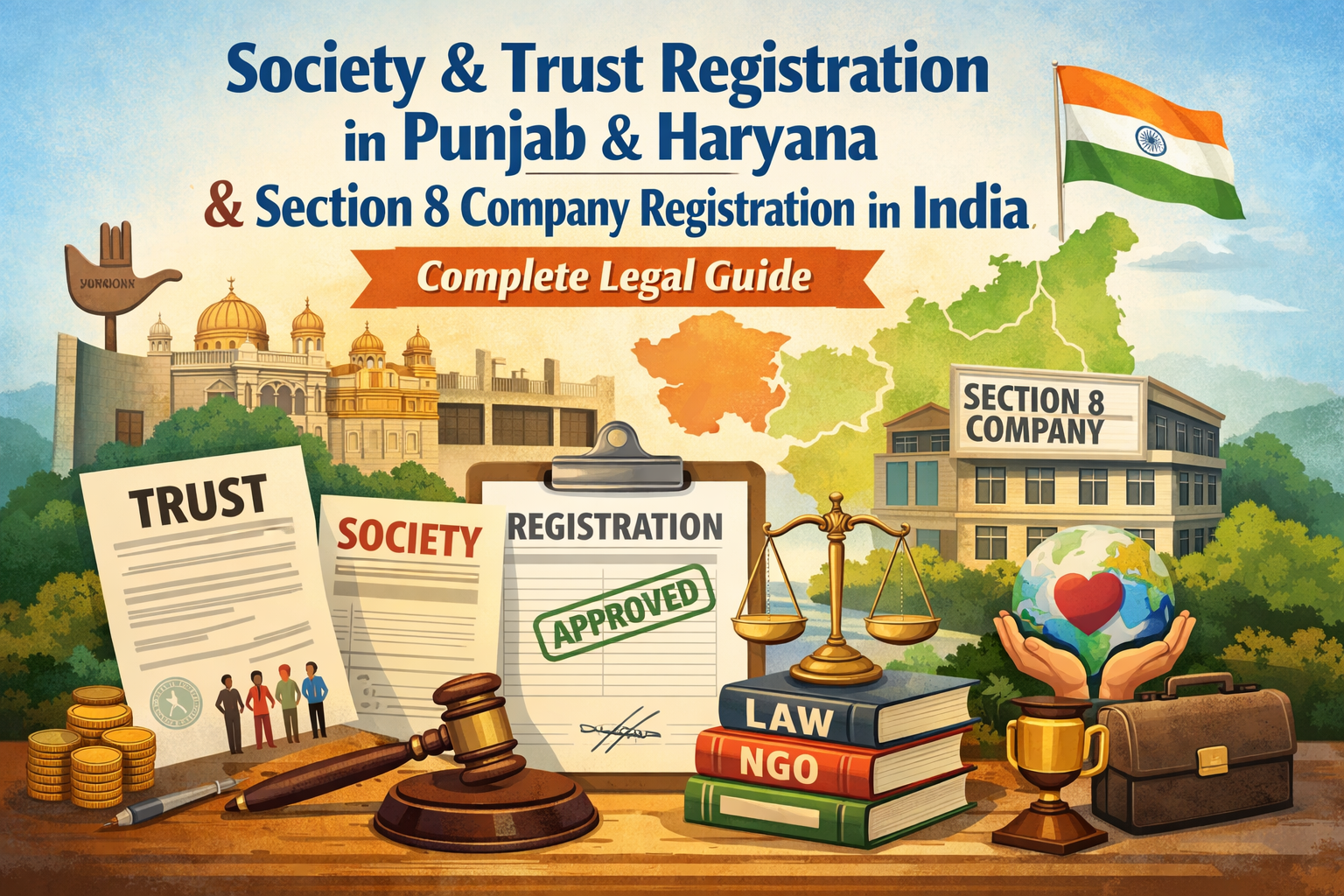
The process of society and trust registration in Punjab and Haryana and sec 8 company in pan india allows NGOs to operate legally and receive donations from individuals, corporations, and government agencies.
2.Types of Non-Profit Organizations in India
India offers three main legal structures for nonprofit organizations.
Society Registration
A society is formed by a group of individuals who come together for charitable or educational purposes.
Societies are governed by the Societies Registration Act, 1860.
Common activities include:
Educational institutions
Cultural organizations
Community development programs
Societies are widely used for NGOs operating at state or national levels.
Trust Registration
A trust is created when a person transfers property or assets to trustees for charitable purposes.
Trusts are governed by the Indian Trusts Act, 1882.
Trusts are commonly formed for:
Religious activities
Charity foundations
Social welfare initiatives
Section 8 Company
A Section 8 Company is a nonprofit organization registered under the Companies Act, 2013.
Unlike societies and trusts, Section 8 companies are regulated by the Ministry of Corporate Affairs (MCA).
They are often preferred for large NGOs and international organizations.
3.Society Registration in Punjab and Haryana
Society registration is widely used for NGOs in Punjab and Haryana.
Legal Act Governing Societies
Societies in Punjab and Haryana are governed by:
The Societies Registration Act, 1860
This law regulates the formation, management, and functioning of societies.
4.Registration Procedure
The procedure for society and trust registration in Punjab and Haryana and sec 8 company in pan india begins with society registration.
Steps include:
1. Choose a unique society name
2. Prepare the Memorandum of Association (MOA)
3. Draft rules and regulations
4. Submit documents to the Registrar of Societies
5. Obtain the society registration certificate
Registration usually takes 10–20 days.
5.Trust Registration in Punjab and Haryana
Trust registration is another common structure for charitable organizations.
Types of Trusts
There are two main types of trusts:
Public Trust – Created for charitable purposes
Private Trust – Created for family or individual benefits
Most NGOs register as public charitable trusts.
6.Trust Deed Requirements
The trust deed is the most important document for trust registration.
It must include:
Name of the trust
Objectives of the trust
Details of trustees
Trust property information
The trust deed must be executed on stamp paper.
7.Registration Process
Steps for trust registration:
1. Draft trust deed
2. Get deed notarized
3. Submit documents to Sub-Registrar office
4. Pay registration fees
5. Receive trust registration certificate
Trust registration usually takes 7–15 days.
8.Section 8 Company Registration in India
Section 8 companies are the most structured form of NGO.
What is a Section 8 Company
A Section 8 Company is formed for purposes such as:
Charity
Education
Research
Environmental protection
Social welfare
These companies cannot distribute profits to members.
All income must be used for organizational objectives.
9.Eligibility Criteria
Requirements include:
Minimum 2 directors
Minimum 2 shareholders
Registered office address in India
Directors must obtain DIN (Director Identification Number).
10.Registration Procedure
Steps to register a Section 8 Company:
1. Obtain Digital Signature Certificate (DSC)
2. Apply for Director Identification Number (DIN)
3. Reserve company name
4. File incorporation forms with MCA
5. Receive Section 8 license and Certificate of Incorporation
Registration typically takes 15–25 days.
11.Documents Required for NGO Registration
Common documents required for society and trust registration in Punjab and Haryana and sec 8 company in pan india include:
ID proof of members (Aadhar/PAN/Passport)
Address proof of members
Passport-size photographs
Registered office address proof
Utility bill or rent agreement
Memorandum of Association (MOA)
Trust Deed or Articles of Association
Additional documents may be required depending on the organization type.
12.Cost of Society, Trust and Section 8 Registration
Registration costs vary depending on professional services and government fees.
Organization Type Estimated Cost
Society Registration ₹8,000 – ₹20,000
Trust Registration ₹6,000 – ₹15,000
Section 8 Company ₹20,000 – ₹60,000
Professional consultants may charge additional fees for legal drafting and compliance.
13.Benefits of Registering an NGO
Registering an NGO provides several advantages.
1. Legal Recognition
Registered organizations gain legal identity and credibility.
2. Ability to Receive Donations
NGOs can legally accept donations from individuals and corporations.
3. Government Funding Opportunities
Registered NGOs can apply for government grants and welfare schemes.
4. Tax Benefits
Organizations can obtain tax exemptions under the Income Tax Act.
14.Compliance Requirements
NGOs must follow certain compliance rules.
These include:
Annual financial statements
Income tax return filing
Renewal of registration (if applicable)
Maintenance of records
Section 8 companies have stricter compliance requirements compared to trusts and societies.
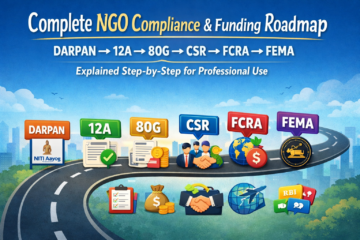
12A and 80G Tax Exemption
NGOs can apply for tax exemptions through:
12A Registration
Allows NGOs to claim income tax exemption.
80G Certification
Allows donors to claim tax deductions for their contributions.
These benefits encourage charitable donations.
15.Frequently Asked Questions
1. Which is better: Society, Trust, or Section 8 Company?
Section 8 companies offer higher credibility and transparency, while trusts and societies are easier to manage.
2. How long does NGO registration take?
Trust: 7–15 days
Society: 10–20 days
Section 8 Company: 15–25 days
3. Can foreigners become members of NGOs in India?
Yes, foreign nationals can be members, but additional regulatory approvals may be required.
4. Can NGOs receive foreign donations?
Yes, NGOs must obtain FCRA registration to receive foreign contributions.
5. Is GST required for NGOs?
GST registration is required only if the organization provides taxable services.
6. Can one person start a trust or society?
A trust can be started with a minimum of two trustees, while a society requires
seven members.